India dismantled its centralized journal quality watchdog in 2024. Was it a blow to academic integrity, or a long-overdue exercise of institutional freedom?
What is Article 19 of the Indian Constitution?
Article 19 is one of the most vital provisions in Part III (Fundamental Rights) of the Indian Constitution. It guarantees six core freedoms to every citizen – freedoms that form the democratic backbone of Indian society.
Article 19 & Academic Publishing
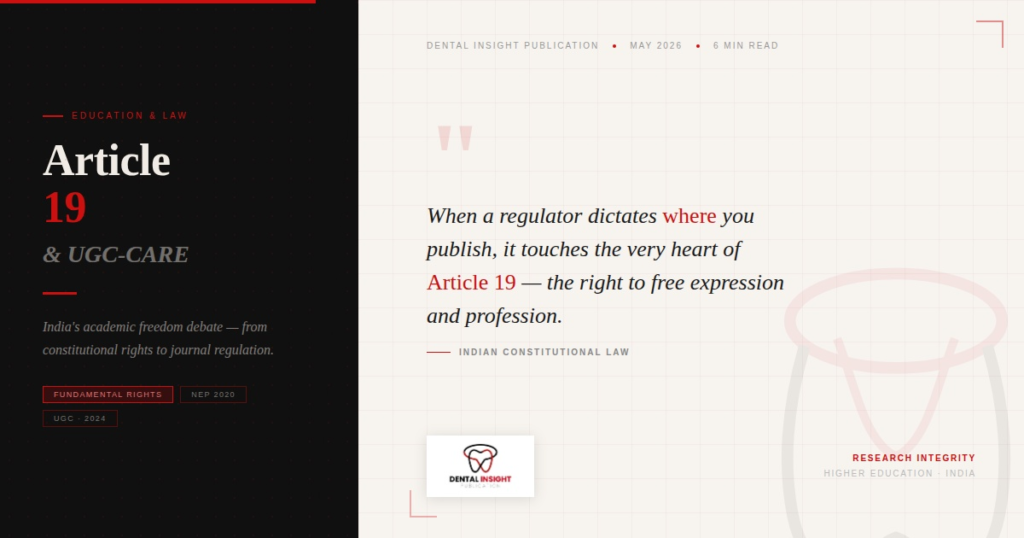
The right to publish research falls squarely under Article 19(1)(a) freedom of speech and expression and Article 19(1)(g) freedom of profession. When a regulatory body like UGC mandates where academics must publish to qualify for promotions, it imposes a restriction on these freedoms. Whether that restriction is “reasonable” became a live debate after 2018.
What was the UGC-CARE List?
The UGC-CARE (Consortium for Academic and Research Ethics) list was introduced in 2018 by the University Grants Commission to tackle a growing crisis in Indian academia: the explosion of predatory journals.
Pre-2018
Indian researchers increasingly publish in low-quality, pay-to-publish journals with no real peer review. Promotions and funding were being awarded for dubious publications.
2018
UGC launches the CARE List — a curated database of quality-vetted academic journals. Publications in CARE-listed journals become mandatory for faculty appointments and promotions.
2020–2023
NEP 2020 criticizes over-centralization in academia. Researchers begin raising concerns about delays, opaque inclusions, and exclusion of reputed Indian-language journals from the list.
Oct 3, 2024
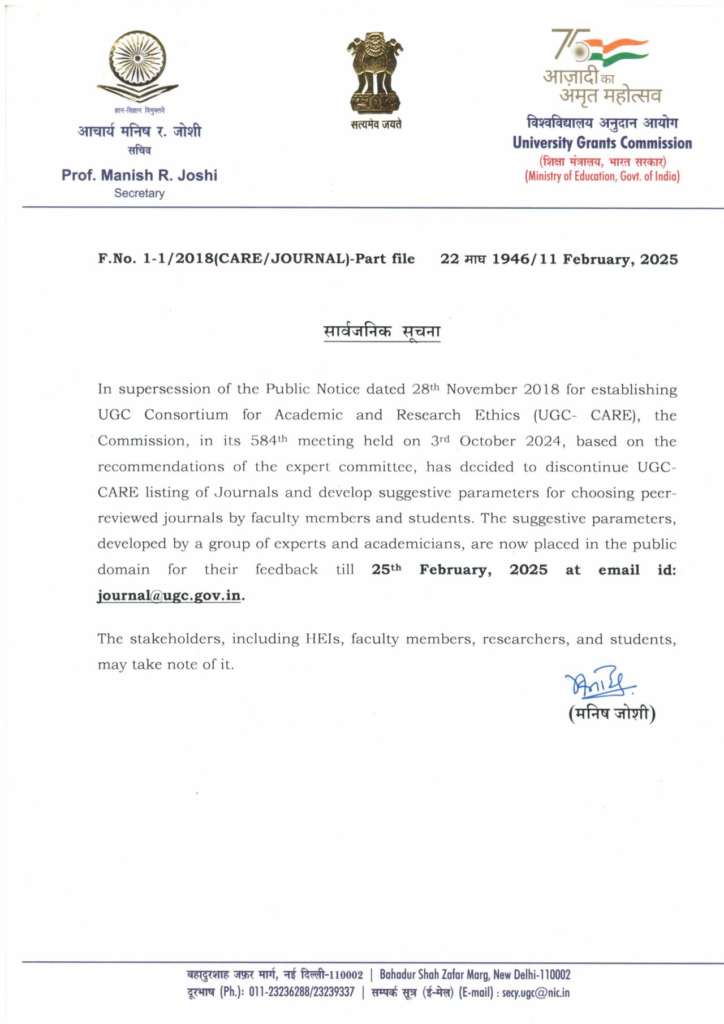
At its 584th meeting, the UGC Commission formally votes to discontinue the CARE List. A decentralized, parameter-based approach is announced in its place.
Feb 2025
UGC officially publishes the new “suggestive parameters” for journal selection, shifting responsibility to individual Higher Education Institutions (HEIs).
Why was UGC-CARE dissolved?
The UGC cited multiple systemic failures in its decision, framed within the spirit of NEP 2020’s push for institutional autonomy:
Over-centralization: A single body controlling journal quality for the entire country’s academic system was seen as incompatible with the NEP 2020 vision of decentralized, institution-led governance.
Lack of transparency: There was no clear, publicly accessible rationale for why specific journals were included or excluded from the list, creating distrust among researchers.
Update delays: The list was rarely updated in time, meaning emerging journals — including credible new ones — were locked out while stale or compromised journals remained listed.
Predatory journals still crept in: Despite being designed to screen out predatory journals, the vetting process was porous. Questionable journals found their way onto the list, defeating the very purpose.
Exclusion of Indian-language journals: Respected and established journals in Hindi, Tamil, Kannada, and other Indian languages were systematically left out, marginalizing vernacular scholarship.
Concerns over the decision
The move has not been without sharp criticism from academics across the country. Scholars warn the shift could reverse hard-won gains against predatory publishing:
Return of predatory journals: Without a centralized quality benchmark, critics fear researchers — especially those under pressure to publish — will once again resort to dubious, pay-to-publish outlets.
Monopoly of international databases: Scrapping CARE may hand disproportionate gatekeeping power to private, commercial databases like Scopus and Web of Science, which are expensive to access and biased toward English-language research.
Inconsistent standards across institutions: Different universities applying different criteria for “peer-reviewed journals” could create a fragmented, unequal research ecosystem where quality varies wildly.
India’s global research ranking: Scholars warn the decision may negatively impact India’s standing in international academic rankings, at a time when India is actively trying to raise its research output and quality.
What replaces CARE?
The UGC has introduced a set of eight suggestive parameters developed by a panel of academicians and subject experts to help faculty evaluate journals. These cover aspects like peer-review integrity, indexing status, editorial board transparency, publication frequency, and citation standards.
Critically, the word “suggestive” is doing heavy lifting here. These are guidelines, not mandates. Each Higher Education Institution is now responsible for interpreting and applying these parameters – a reform that expands autonomy on paper but places enormous accountability on institutions that may lack the capacity or will to exercise it rigorously.
Notice Showing the Discontinuation of UGC CARE LIST
Are you a dental professional, student, or researcher with a story to tell? Join our growing community of academic writers — email us at dentalinsightpublication@gmail.com or WhatsApp +917004837260 and get published today!