Pubmed
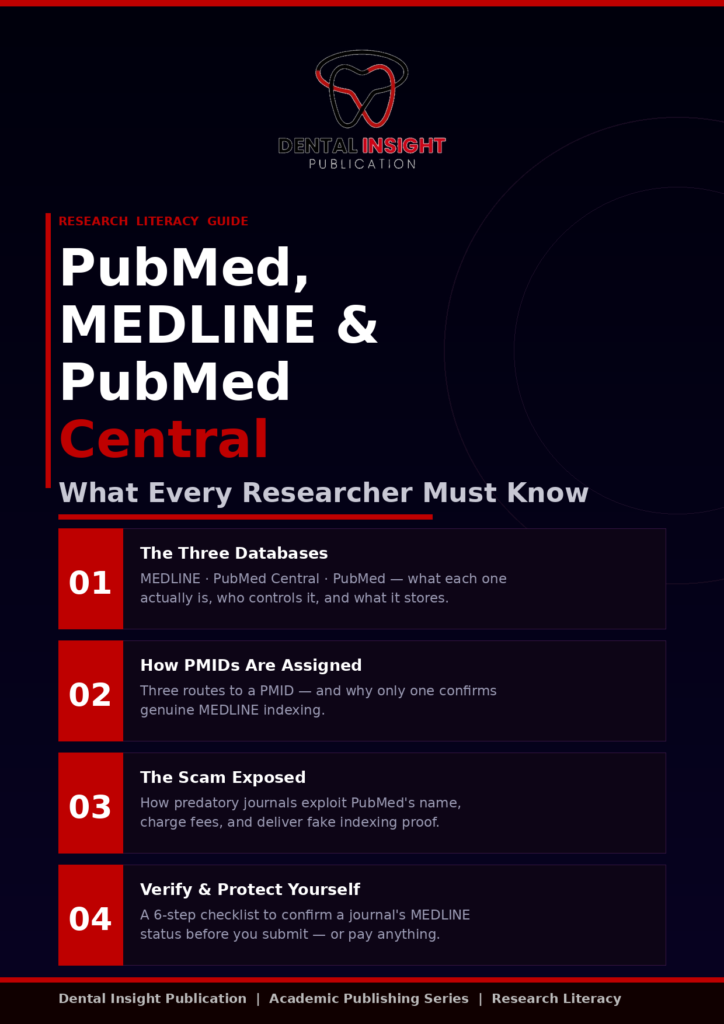
Three databases that share a name but are not the same thing — and one widespread scam that exploits the confusion to take your money.
If you have ever submitted a research paper, you have almost certainly seen it: a journal promising “indexing in PubMed NLM.” It sounds prestigious. It sounds official. For thousands of researchers — especially early-career scientists — it is enough to open their wallets.
But here is what most researchers are never told: PubMed NLM, MEDLINE, and PubMed Central are three distinct things with three entirely different entry criteria. Getting into one does not mean getting into another. And “PubMed NLM indexing” as a selling point is almost always a fraud.
1. The Three Databases — What They Actually Are
At a glance
| Feature | MEDLINE | PubMed Central | PubMed NLM |
| Type | Citation database | Full-text archive | Search interface |
| Run by | NLM / LSTRC | NLM | NLM |
| Assigns PMID? | Yes (with MeSH) | Yes + PMCID | Displays only |
| Full text stored? | No (abstracts) | Yes | No (links out) |
| Peer review required? | Strictly | Yes, moderate | N/A |
| Open access mandate? | No | Yes | N/A |
| Prestige level | Highest | Moderate | N/A |
| Entry bar | Very strict | Moderate | None |
MEDLINE — The Gold Standard
MEDLINE is the flagship database of the U.S. National Library of Medicine (NLM). It contains over 27 million citations covering biomedicine, life sciences, behavioural sciences, nursing, dentistry, and healthcare — going back to the 1940s.
A formal committee called the Literature Selection Technical Review Committee (LSTRC) evaluates every journal application. Journals must demonstrate rigorous peer review, editorial quality, scientific merit, and a consistent publication track record — typically at least two years — before being considered.
Every article indexed in MEDLINE receives a PMID (PubMed ID) — a unique number assigned by NLM. Articles are also tagged with MeSH (Medical Subject Headings) terms by trained NLM indexers. This MeSH tagging is the technical step that distinguishes true MEDLINE indexing from everything else.
PubMed Central (PMC) — The Open-Access Archive
PubMed Central is a free, full-text digital archive launched in 2000 to support open access. Unlike MEDLINE, which stores only citations and abstracts, PMC stores complete articles in standardised digital formats. Many funding agencies — including NIH and the Wellcome Trust — mandate that grant-funded research be deposited in PMC.
PMC has its own review process, separate from MEDLINE. Some journals are in PMC but not MEDLINE. Some are in MEDLINE but not PMC. Many top journals are in both. Being in PMC is legitimate and meaningful — but it is a lower bar, and it is not the same as MEDLINE indexing.
Articles in PMC receive both a PMID and a separate PMCID (e.g., PMC1234567). A PMCID is not a substitute for MEDLINE indexing.
PubMed — A Search Engine, Not a Database
Here is the most common misconception: PubMed is not a database. It is a free web interface — a search engine built and maintained by NLM — that lets you search across MEDLINE and a few connected sources.
When researchers say “indexed in PubMed” they almost always mean “indexed in MEDLINE.” PubMed simply displays what is in MEDLINE. PubMed also surfaces publisher-submitted records and in-process citations that are awaiting full review. These can appear in PubMed search results with a PMID but without any MEDLINE indexing — and this is exactly what scammers exploit.
2. How a PMID Is Actually Assigned — and Why It Can Mislead You
The existence of a PMID is commonly mistaken for proof of MEDLINE indexing. It is not. There are three distinct routes to receiving a PMID, and they carry very different levels of credibility.
| 1 | Full MEDLINE indexing → genuine PMID with MeSH terms The journal must first be approved by the LSTRC. Individual articles are then reviewed and tagged with MeSH terms by NLM indexers. Only these PMIDs carry the full weight of MEDLINE citation. This is the only process that produces a truly “indexed in MEDLINE” publication. |
| 2 | PMC deposit → PMID + PMCID (legitimate, but not MEDLINE) Articles submitted to PubMed Central receive both a PMID and a PMCID. This PMID is assigned by NLM and is real — but it does not confirm MEDLINE indexing. PMC acceptance is a separate, less strict process from MEDLINE selection. |
| 3 | Publisher-submitted metadata → provisional PMID (the danger zone) Publishers can submit article metadata to NLM via programmes like LinkOut. The NLM system may assign a provisional PMID to this stub record — even with no peer review, no MeSH indexing, and no journal approval whatsoever. This is the PMID that predatory journals show authors as “proof” of indexing. |
| KEY RULE True MEDLINE indexing is confirmed by the presence of MeSH terms on the article record and the journal’s approved status in the NLM Catalog — not by the existence of a PMID. |
| NOTE ON FUNDING NLM does not restrict PMIDs to funded studies. Any article that meets MEDLINE’s editorial and scientific standards can be indexed — regardless of whether the research was externally funded. The confusion arises because NIH and several other funding agencies require that grant-funded research be deposited in PubMed Central as a condition of the grant. That is a funder policy, not an NLM rule. Funding status has no bearing on whether an article receives a PMID. |
3. The Scam — How Researchers Lose Money in PubMed’s Name
| ⚠ THE “PUBMED NLM INDEXING” FRAUD There is no database called “PubMed NLM.” NLM is the institution; PubMed is the search tool it runs. But predatory publishers combine these words — along with “MEDLINE” — to fabricate a credential that sounds authoritative. And it works, because the claims are technically constructed to be misleading rather than outright false. |
The Typical Pitch
| From: editor@internationaljournalofmedicalsciencesxyz.com Subject: Invitation to Publish — Special Issue Closing Soon Dear Dr. [Name], We cordially invite you to submit your research to our internationally recognised, peer-reviewed journal, fully indexed in PubMed / NLM / MEDLINE. We guarantee fast publication within 2–4 weeks. Our journal carries a high impact factor recognised by leading indexing bodies. Article Processing Charge: USD 500 (waiver available for select submissions). Deadline: This Friday. Submit now to secure your place. |
What Actually Happens After You Pay
- The journal submits your article metadata to NLM via the LinkOut programme — a publisher-facing tool that is explicitly not an indexing application.
- NLM automatically assigns a provisional PMID to the submitted stub record.
- The journal sends you a PubMed URL showing your article with a PMID and calls it “proof of NLM indexing.”
- There are no MeSH terms. No LSTRC approval. No real peer review. The article is not indexed in MEDLINE.
- The journal often folds, rebrands, or disappears within months. Your money is gone. Your “publication” may be unverifiable or retracted.
The Language Tricks Predatory Journals Use
Because outright lying about MEDLINE indexing creates legal risk, predatory publishers use deliberately ambiguous language. Here are the most common formulations:
| The Claim | What It Actually Means |
| “Listed in NLM Catalog” | Any journal can appear in the NLM Catalog — it is a catalogue, not a list of MEDLINE-approved journals. True and meaningless at the same time. |
| “Available on PubMed” | Metadata stubs submitted via LinkOut can appear in PubMed search results. This does not indicate any form of indexing approval. |
| “Recognised by NLM” | NLM does not “recognise” journals in this way. The phrase has no official meaning and is designed to sound like an endorsement. |
| “PubMed Central indexed” | PMC acceptance is legitimate, but routinely misrepresented as equivalent to MEDLINE indexing. They are entirely separate processes. |
4. Red Flags — How to Spot a Predatory Journal Before You Pay
- Acceptance promised within days of submission. Genuine peer review takes weeks to months.
- Article Processing Charge (APC) requested before peer review has taken place.
- Journal name closely resembles a well-known, established journal.
- Impact factor is absent, suspiciously high, or attributed to an unrecognised indexing body — not Clarivate/Web of Science or Scopus.
- Countdown timers, “special issue” urgency, or the initial contact was an unsolicited email to your institutional address.
- Editorial board members are unfindable online, or prominent researchers deny being on the board.
- The journal’s website has broken links, stock photography, and vague scope descriptions.
- No ISSN number, or the ISSN does not match NLM Catalog records.
| ✓ HOW TO VERIFY A JOURNAL’S ACTUAL MEDLINE STATUS (2 MINUTES) Step 1 — Go to the NLM Catalog: ncbi.nlm.nih.gov/nlmcatalog Step 2 — Search the journal name exactly as it appears on the journal’s website. Step 3 — Look for the exact phrase “Currently indexed for MEDLINE” in the journal record. This phrase must be present. Step 4 — If it says only “PubMed Central” — it is in PMC but not MEDLINE. Legitimate, but different. Step 5 — For indexed journals, listing in Web of Science (Clarivate) or Scopus (Elsevier) provides additional confirmation. |
5. The Summary — Three Lines Every Researcher Should Know
| MEDLINE | The real standard. Strict NLM/LSTRC selection. PMIDs with MeSH indexing. Verify at the NLM Catalog. This is what “PubMed indexed” actually means when people use the phrase correctly. |
| PMC | Legitimate open-access archive. Lower bar than MEDLINE. Important for funder open-access mandates. A PMCID is not a MEDLINE citation. |
| PubMed | A search engine, not a database. Finding your article here does not indicate MEDLINE indexing. A PMID alone proves nothing about indexing quality. |
| A PMID alone proves nothing. Always verify a journal’s indexing status at the NLM Catalog — before you submit, and before you pay any article processing charge. If you cannot confirm “Currently indexed for MEDLINE” in the NLM Catalog, the claim is unverified — regardless of what the journal’s website states. |
Published for educational purposes. Researchers are encouraged to verify journal indexing independently through NLM’s official catalog before submitting manuscripts or paying any article processing charges.
Are you a dental professional, student, or researcher with a story to tell? Join our growing community of academic writers — email us at dentalinsightpublication@gmail.com or WhatsApp +917004837260 and get published today!