Image Source: https://www.yankodesign.com/2026/09/01/dysons-499-camera-toothbrush-is-so-advanced-they-had-to-redesign-the-toothpaste-for-it/
Dyson has a habit of walking up to boring, settled objects and asking an annoying question: why is this still like this? It happened to the vacuum, the hand dryer, the hair dryer, and the desk fan. This time the target is the humble toothbrush — and the answer Dyson came up with is a brush with a camera inside it.
Unveiled by James Dyson in Paris at the start of September 2026, the Dyson CameraJet is the company’s first move into oral care. It is strange, ambitious, faintly ridiculous, and — depending on your relationship with flossing — possibly brilliant. But the moment you put a camera in the most private room in the house, there’s a bigger question waiting behind the tech specs: what happens to what it sees? Here’s what the device actually does, how it was built, and why the privacy question deserves a straight answer.
The one-sentence pitch
The CameraJet is a sonic electric toothbrush with a tiny camera and a liquid jet built into the head. As you brush, the camera looks for the gaps between your teeth, and the jet fires a precise burst of mouthrinse into each gap it finds — flossing you, in effect, while you brush.
That’s the headline. The interesting part is how it pulls it off.
The camera and the jet
Packed into the brush head is a 100,000-pixel macro camera roughly a millimetre across. It captures around 28 images every second, and Dyson’s machine-learning software analyses that live feed to detect, track, and even predict the interdental gaps — the spaces between teeth where plaque loves to hide and brushes tend to skate right over.
When the system spots a gap, it triggers the jet within about a tenth of a second. Rather than the thin, needle-like stream you get from a traditional water flosser, Dyson uses a wider conical jet. The claim is that a cone dislodges more plaque across the whole gap while being gentler on your gums and enamel than a high-pressure needle that can effectively stab through the plaque.
If the idea of a lens inside your mouth makes you uneasy, Dyson’s answer is that the images are processed on the device itself — not stored, not uploaded, not shared.
It’s a genuinely good brush, not just a gimmick
It would be easy to dismiss all this as a camera bolted onto an ordinary brush, but the brushing hardware is where six years of engineering quietly shows up.
Conventional sonic brushes have a weakness: press too hard and the bristles stall against the tooth, killing the very vibration that’s supposed to be cleaning you. Dyson’s variable sonic oscillation is designed to keep the bristles moving no matter what, an anti-stall trick the company says removes up to 69% more plaque than the leading sonic electric brushes.
The brush head itself is contoured rather than flat — the logic being that teeth aren’t flat either. A dual-bristle design follows the gumline and lifts surface stains, and you get three intensities to choose from: Gentle, Variable, and Deep clean. You can also run it in brush-only or floss-only mode if you don’t want the full see-and-jet routine every time.
In lab testing using a proxy plaque developed with the National University of Singapore, Dyson says the CameraJet cleared nearly 70% more plaque from hard-to-reach areas than premium electric toothbrushes. A separate six-week clinical study of 204 people backed up the gum-health claims against a manual brush.
Six years, 661 engineers and 38 patents
If you’re going to charge toothbrush-money-times-ten, you’d better have the engineering story to back it up — and this is where Dyson lays it on thick.
By the company’s own account, the CameraJet took six years to develop, involved 661 engineers, and generated 38 patent filings. It runs on roughly 16 million lines of code, and the AI that spots the gaps was trained on more than 470,000 dental images gathered during development. To test whether the jet actually removed plaque without running a clinical trial for every tweak, Dyson says its team even created a synthetic “proxy plaque” through a multi-year collaboration with the National University of Singapore’s Faculty of Dentistry.
A few of the technologies Dyson highlights as its own:
- Gap Optical Targeting™ — the trademarked system at the centre of it all. A 100,000-pixel (0.1-megapixel) macro camera sits just under the brush head and, per Dyson, analyses 28 live images a second to identify, track and predict the gaps between your teeth, firing the jet within about 100 milliseconds of seeing one.
- The conical jet — Dyson’s fluid-dynamics team spent years shaping the spray. Where a conventional water flosser uses a narrow “needle” stream, Dyson uses a cone that, it claims, covers more of the gap at a gentler pressure.
- Variable sonic oscillation — the anti-stall motor that keeps the bristles moving even when you press hard, said to run at around 245 movements per second.
patent filings are not the same as granted patents, and a big patent count signals investment and intent more than it proves the tech is untouchable. But it does tell you this wasn’t a badge slapped on someone else’s brush — it’s built from the ground up, which is very much the Dyson pattern.
Design and the spec sheet
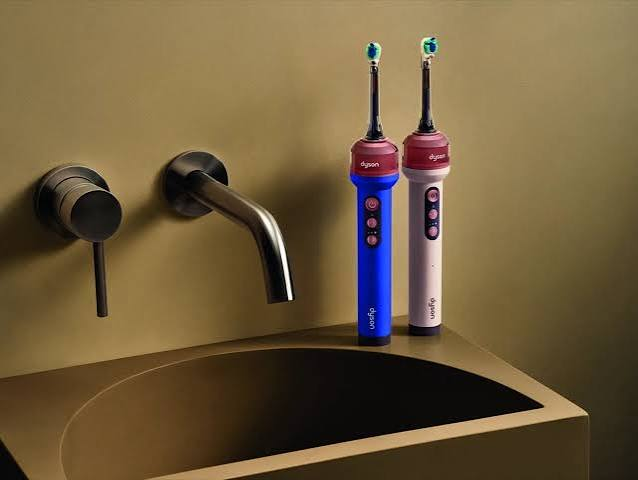
Aesthetically, the CameraJet looks the part. It launches in two ceramic-inspired finishes — Ceramic Ultra Blue and Ceramic Pink with the polished, deliberately over-designed look Dyson buyers expect from the shelf.
The practical details worth knowing:
- A slim 12.5 ml reservoir wraps around the neck of the brush — only about two and a half teaspoons — so the mouthrinse is delivered in tiny, targeted bursts rather than pooling in your mouth.
- The refill dock tops up that reservoir in around three seconds at the press of a button, and also charges and stores the brush upright. Dyson quotes up to roughly 14 full cleans per charge.
- The device uses a swappable lithium-ion battery and USB-C charging, and the box includes a travel case and spare dual-bristle brush heads.
- There’s a matching toothpaste and mouthrinse, and the formulation choice is genuinely clever: the toothpaste is non-foaming and made without SLS, and the rinse is low-foaming largely so that foam doesn’t cloud the camera’s view. Both are made with sodium fluoride, and Dyson has talked about mint-family flavours plus a sensitive variant.
Taken together, it’s less “toothbrush” and more a small, sensor-laden appliance that happens to live by your sink.
Your dentist, sort of, in an app
Everything the camera sees feeds into the MyDyson app, and this is where the product gets a little sci-fi. You can watch live footage of your own teeth as you brush — actually see what your dentist sees. The app maps your coverage so you know which spots you keep neglecting, nags you when you’re pressing too hard or using the wrong technique, and builds up trends over time so your oral health becomes something you can look at as data.
Whether you want a high-resolution look at your own molars every morning is a personal question. But for anyone who’s ever been told at a checkup that they “miss the back left” without knowing what that means, the feedback loop is legitimately useful.
A whole “dental system,” not just a brush
Dyson isn’t stopping at hardware. A docking station refills the brush’s reservoir at the touch of a button in about three seconds, charges the device between uses, and stores it upright and hygienically. A travel case comes in the box. And to go with it all, Dyson is developing its own SLS-free (non-foaming) toothpaste and low-foaming mouth rinse designed for the jet.
The message is clear: Dyson doesn’t want to sell you a toothbrush. It wants to own your entire bathroom sink.
Let’s talk about the $499 elephant
Here’s the number that’ll stop most people: the CameraJet costs around $499. That is not a toothbrush price. That’s a small-appliance price — which is very on-brand for a company whose vacuums and hair dryers already ask you to pay a serious premium for engineering you can feel.
Is it worth it? If you floss diligently and your dentist has no complaints, probably not — a good $60 sonic brush and a spool of floss will keep you healthy. But if you don’t floss (which is most of us, if we’re honest), and the reason is that flossing is fiddly and forgettable, then a device that does it automatically and shows you the results might be the thing that finally changes the habit. For some people, that’s worth $499. For most, it’ll be a fascinating thing to read about and not buy.
A camera in the one room we keep private
Let’s address the thing that probably crossed your mind the moment you read “camera”: it lives in the bathroom.
The washroom is, for most of us, the single most private space in the house. So the instinct to pause at a camera-equipped device there is completely understandable, and it’s worth talking about openly rather than pretending it isn’t a question.
Here’s what Dyson says on the record. According to the company, the camera only looks inside your mouth while you brush, the images are processed on the device itself, and — again, per Dyson — that footage is not stored or shared. In other words, the company positions it as a lens pointed at your teeth, held in your own hand, rather than a connected camera watching the room.
That’s Dyson’s stated position, and it’s a reasonable one on paper. But if privacy matters to you, the sensible move with any connected device — this one included — is to check the details for yourself before you buy: what the companion app can access, what permissions it requests, whether anything syncs to the cloud, and what the current privacy policy actually says. Those terms can change over time and can differ by country, so treat the manufacturer’s own up-to-date documentation as the source of truth. None of this is a claim that the device does anything it shouldn’t; it’s simply the ordinary due diligence any camera-and-app product deserves, and Dyson has publicly leaned into the “processed on device, not stored” message precisely because it knows people will ask.
Will India actually buy it?
That brings us to the more interesting question for readers here: is there a market for this in India?
A few facts first. As of early September 2026, Dyson had not announced official India pricing or a firm launch date, and its India website was inviting people to register for availability updates. Converted from the US price of roughly $499, the device lands somewhere in the region of ₹42,000–₹48,000 — and it’s fair to say that is a striking number for a toothbrush by any Indian standard.
So will people pay it? Honestly, that’s an open question, and anyone claiming certainty either way is guessing. Here’s how I’d frame the two sides.
On the sceptical side: for that kind of money, a shopper could buy an excellent electric toothbrush and a separate water flosser and still have thousands of rupees left over. For most households, a well-priced sonic brush and regular flossing does the job. At ₹40,000-plus, this is not a mass-market product, and it would be surprising if it became one quickly.
On the optimistic side: Dyson has done this before. Its vacuums, the Airwrap and its hair tools all carry premium price tags, and a segment of urban Indian buyers has consistently paid for the design, the novelty and the status that a Dyson badge carries. Oral care could follow the same pattern — starting with loyalists, gadget enthusiasts and people for whom the object is partly a statement, before anyone talks about wider adoption. Some commentators have gone further and suggested oral care could eventually become a major category for the brand. Whether that optimism pans out is something only time and sales figures will settle.
My own take, offered as opinion rather than prediction: expect curiosity and screenshots first, considered purchases second. The people most likely to hesitate aren’t hesitating over the camera so much as the price — and in a market as value-conscious as India, price is the harder objection to overcome.
The verdict
The Dyson CameraJet is exactly the kind of product Dyson exists to make: over-engineered, expensive, a little absurd, and genuinely clever underneath the spectacle. Putting a camera in your mouth to guide a flossing jet sounds like a punchline until you realise it’s solving a real problem — that we brush blind and floss badly.
Will it change how everyone cleans their teeth? No. Will it make a certain kind of person very happy to spend $499 watching plaque disappear in real time? Absolutely. And either way, Dyson has done the thing it always does — made us look at an object we stopped thinking about years ago and wonder why we ever accepted it as finished.
This article is opinion and commentary based on publicly available information at the time of writing (September 2026). Product features, specifications, pricing and privacy terms are described as reported by the manufacturer and may change — please verify current details directly with Dyson before making any purchase. Any performance figures mentioned are the manufacturer’s own claims. Nothing here is legal, medical, dental or financial advice.